
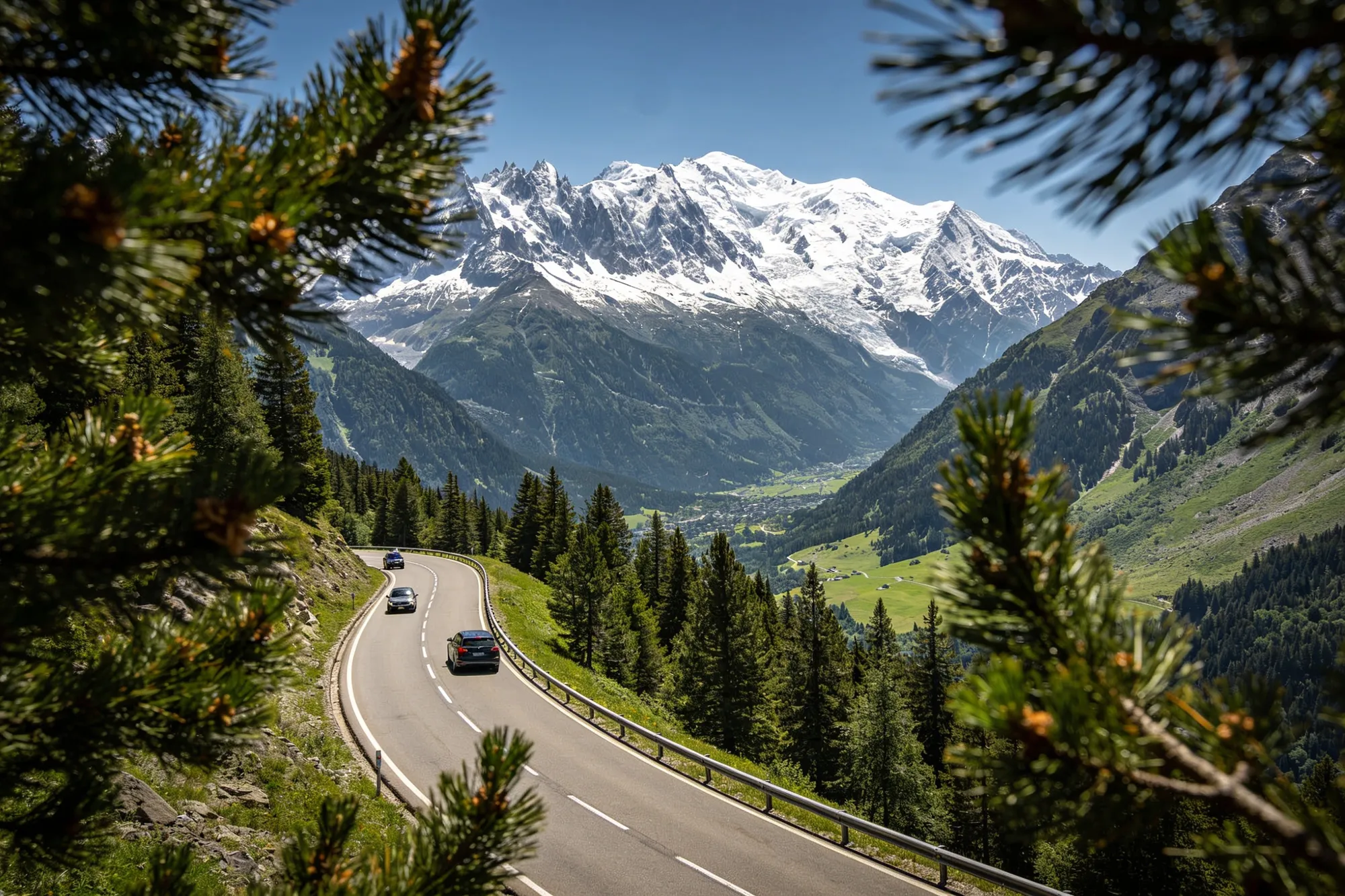
Geneva is the natural gateway to Chamonix: its airport is the closest to the valley, about 88 km away by road, a journey of 1 to 1.5 hours depending on traffic. It is one of the busiest transfers in the Alps, especially in winter. Four options exist: car, shared shuttle, private transfer and public transport (bus or train). The right choice depends on your budget, your luggage, and whether you arrive at the airport or in the city.
Here is each option in detail, with times, sample prices and the pitfalls to avoid.
In short: which option to choose
| Option | Time (no traffic) | Sample price | Who it suits |
|---|---|---|---|
| Hire car | 1 h – 1 h 30 | Hire + tolls + fuel | Families, touring trips, freedom |
| Shared shuttle | 1 h 15 – 2 h | €30–40 per person | Couples, small groups, controlled budget |
| Private transfer / chauffeured car | 1 h – 1 h 15 | from ~€150 per vehicle | Groups, families with luggage, comfort |
| Bus (FlixBus, etc.) | 1 h 15 – 2 h | from ~€11 | Tight budget, light travellers |
| Train (via Saint-Gervais) | ~3 h, 2 changes | variable SNCF fares | No car, scenic journey |
By car
The most direct route takes the A40, the “Autoroute Blanche”, to the Le Fayet exit (Saint-Gervais), then the RN205 up the Arve valley to Chamonix. With no traffic, allow 1 to 1 h 15 from the airport.
A few things to know:
- Tolls and vignette. On the French side, the A40 is a toll road. Depending on the route you take out of Geneva, a Swiss motorway vignette may be required for the stretch of motorway in Switzerland (around 40 CHF, for the year). Check with your hire company whether the car already has one.
- Border. Crossing the France–Switzerland border can slow down at peak times and on school-holiday weekends. Allow some margin.
- Geneva Airport. It has a French sector and a Swiss sector: to hire a car on the French side, follow the “France sector”, which avoids the Swiss motorway.
- Winter. From 1 November to 31 March, the “loi Montagne” requires winter equipment (snow tyres or chains) in the Chamonix valley. Snow can lengthen the journey considerably.
- On arrival. Chamonix is largely pedestrianised and parking is paid and limited: go for covered car parks or accommodation with parking, then the valley’s free shuttles.
The car remains the most flexible choice for a family or a trip that combines several villages (Les Houches, Argentière, Saint-Gervais).
By shared shuttle
Door-to-door shared shuttles are the most popular option from the airport. Several companies run continuously between Geneva Airport and accommodation across the Chamonix valley, grouping travellers in a minibus. Allow €30 to €40 per person and around 1 h 15 of travel, a little more depending on stops and the weather.
This is the best value for comfort for a couple or a small group without a car: you are dropped near your accommodation, with no driving or parking to deal with. Book ahead, especially in the high ski season.
By private transfer or taxi
For a private transfer (dedicated minibus or chauffeured car), prices start at around €150 per vehicle and rise with the size of the group and the season. The advantage: departure at the time you want, a direct journey with no other stops, and room for luggage and ski gear. It is the most comfortable option for a large family or a group sharing the cost.
By bus
Coach services (such as FlixBus or BlaBlaCar Bus) link the airport and the city of Geneva to Chamonix, with tickets from around €11 if you book early. The journey takes roughly 1 h 15 to 2 h. It is the cheapest option, ideal for travelling light; on the other hand, services are less frequent and you have to reach the drop-off stop in Chamonix.
By train
The train has no direct link: allow about 3 hours with two changes, but it is a fine scenic, car-free option.
The typical route:
- Léman Express, from Geneva to Saint-Gervais-les-Bains–Le Fayet: about 1 h 45, with one train an hour (two at peak times), via Annemasse and La Roche-sur-Foron.
- Mont-Blanc Express, from Saint-Gervais-Le Fayet to Chamonix: 20 to 26 minutes, a spectacular mountain ride up the valley that then continues towards Argentière, Vallorcine and Switzerland (Martigny).
The train takes longer and suits you less if you have a lot of luggage, but it avoids driving and the hunt for parking, and the Mont-Blanc Express is an experience in itself. Remember to check timetables and connections in advance.
From the city of Geneva (not the airport)
Most travellers arrive at Geneva Airport (GVA), the starting point for all the shuttles. If you set off from central Geneva or Cornavin station, you can take buses and trains directly there; for cars and transfers, allow 15 to 20 minutes more than from the airport. Cornavin station is the starting point of the Léman Express.
Practical tips
- Book early in winter: shuttles, transfers and trains fill up on school-holiday weekends.
- Plan for the border and the weather: a 1-hour journey can double on a snowy Saturday in January.
- Luggage and skis: check the surcharges (skis, snowboard) on shuttles and buses.
- Guest card: in Chamonix, accommodation often gives access to the guest card, which makes the valley’s trains and buses free during your stay. Handy for going without a car once you are there.
- Currency: on the Swiss side you pay in Swiss francs; on the French side, in euros. Most shuttles accept both and take online payment.
Once in Chamonix
Once there, you can get around the valley without a car thanks to the shuttles and the Mont-Blanc Express. The big highlights are within reach: the Aiguille du Midi and its cable car at 3,842 m, the Mer de Glace by the Montenvers train, and the rest of the massif. Full programme on the Chamonix-Mont-Blanc destination page.
Worth noting: the route passes through Saint-Gervais-les-Bains, another gateway to the Mont-Blanc and the terminus of the Mont-Blanc Express, which is also worth the detour (thermal baths, Tramway du Mont-Blanc).